Pritam Rohila Travels

Reports of my travels along with some pictures

Jun 7, 2012

2011, DEC 12: VIETNAM, HO CHI MINH CITY-D

Early n the morning we left for the Cu Chi area, about 40 miles northwest from Ho hi Minh City.

Roads ere congested with hordes of people on motorcycles eading to their jobs. Some people wore masks, pparently to protect themselves from pollution.


Tunnels in the Cu Chi area were used by the iet Cong in their 1960-1975 resistance against the Americans. The tunnels extended o as far places as Cambodia, and allowed the Viet Cong to carry on activities unseeb, ven in the government and U.S. controlled areas.

We isited the Ben Dinh Tunnel Complex hich is one of the areas being preserved as the historic national relic.

For their protection, they built several types of traps against the enemy intruders and scouts.


Also tunnels had camouflaged entrances and exits.


To conceal their location, they had devised ingenious ways to channel fresh air into the tunnels and smoke out, in far-off places.


The complex consisted of underground meeting rooms, hospitals, kitchen facilities, and weaponmaking sites.


Next we went to Tay Nih to visit the Cao Dai Holy See Temple, about15 miles away, for their noon prayer assembly. It is the holy seat of Cao Dai religion, which was founded by Ngo Van Chieu, in Vietnam in 1926. The practitioners are pacifists. They pray four times a day, and consume vegetarian food, 10 days a month.


It is a syncretistic faith based on teachings of Christianity, Islam, Taoism, and Buddhism. The followers of each religious origin are identified by robes of different colors

The Temple’s interior has brightly carved pillars, and colorful murals.


They have adopted nontraditional saints namely, Louis Pasteur, Martin Luther King, Jr., and Victor Hugo.

After lunch at a Vietnamese restaurant, we proceeded to our hotel to enjoy a restful afternoon.

We ended the day with a Dosa dinner at a Saigon, a South Indian restaurant.

Labels: , , , ,

2011, DEC 13: VIETNAM, HO CHI MINH CITY-E

We left our hotel at 8:30 a.m. for the Mekong Delta area. The breadbasket of Vietnam, Mekong Delta accounts for about 50 percent of the nation’s rice production. Also it produces sugar cane, vegetables, fruit, and fish.

On the way, we stopped at Vinh Trang Pagoda, located behind outside Mytho City. The exterior of the pagoda is accentuated with glazed tiles.

A giant statue of Lord Buddha stands across the road, in front. Another large statue of Happy Buddha is situated in the front garden of the Pagoda.


Inside, the main shrine is dedicated to the Buddha with an electric radiating halo.


There are also subsidiary shrines which have been dedicated to important monks related to the Pagoda.


One shrine serves as a memorial, and it displays urns containing remains of some monks. Also, it has pictures of some deceased individuals.


Then we proceeded to the pier to board a boat to explore the Mekong Delta. Many other boats waited for tourists.


First we went across the river to an island, where besides other people we met a family from Malaysia.


Also we tasted fresh fruit and various honey-laced products, did some souvenir shopping, and enjoyed live ethnic music.
Next we cruised to another island, where we sampled food products made from palm trees.

Then we took a pony-cart ride to a point where we boarded a small boat to negotiate through
a small muddy stream back to our large boat for the return trip across the river.


Labels: , , ,

Jun 6, 2012

2011, DEC 16: SIEM REAP TO MYANMAR

Around 11 a.m., we left for the Siem Reap Airport. It is a small airport. The departure Hall has only 4 gates. Things appear quite lax here. Not much attention is paid to people going through the metal detectors. But the carry-on bags are carefully checked.

We boarded the 1:25 p.m., 55-minute Bangkok Air flight from Siem Reap to Bangkok. At Bangkok we took a 5:55 p.m., 75-minute Thai Airways flight to Yangon, in Myanmar.

Dorathy, our local guide received us at the Airport, and whisked us to the Traders Hotel located in the heart of the city.

After a quick bite, we went directly to bed in preparation for our departure for Mandalay, next morning at 6:15.

Labels: ,

2011, DEC17: MYANMAR, AMARAPURA AND MANDALAY

Myanmar is about twice as big as Germany. In ancient times, it was a key land link between traders from India and China, as well as a source of some of its people today.


Majority (65%) are ethnic Bamar. Almost 90% are Theravada Buddhists. Most of them speak the Burmese language, which is a part of the Sino-Tibetan group of languages.

Situated about 600 kilometers north of Yangon on the Irrawaddy River, Mandalay is Myanmar’s
second largest city, and its most reverd cultural and religious centers. It was the capital of the last, independent Burmese Kingdom, which in 1886 was finally conquered by the British colonial forces.

Being surrounded by many former capital of Myanmar, Mandalay area abounds in historical sites, cultural memorials and Buddhist edifices. Primarily pagodas and monasteries still
remain, as most secular buildings of those times, including royal palaces, which had traditionally been built from wood, have disappeared. Many of them were disassembled and construction material thus obtained was use by subsequent Kings to build their own capitals.

Mr. Suday, our local guide, took us directly to Amarapura, “the City of Immortality,” which was King Bodawpaya’s capital, from its foundation by him in 1782 by till 1857, when another King Mindon Min moved the capital to Mandalay.

We went first to the Maha Ganayon Monastery, which is a renowned center for monastic studies.


We watched monks, old and young, moving forward in two lines, at 10:15 a.m. for their day’s only meal.

We also saw where and how the meals were prepared, and the hall where each of them would sit on the floor to consume the food contained three bowls placed on a low-table in front of him.


We also saw where and how the meals were prepared, and the hall where each of them would sit on the floor to consume the food contained three bowls placed on a low-table in front of him.


Before the meal, they take a bath. Some even get their heads shaved.


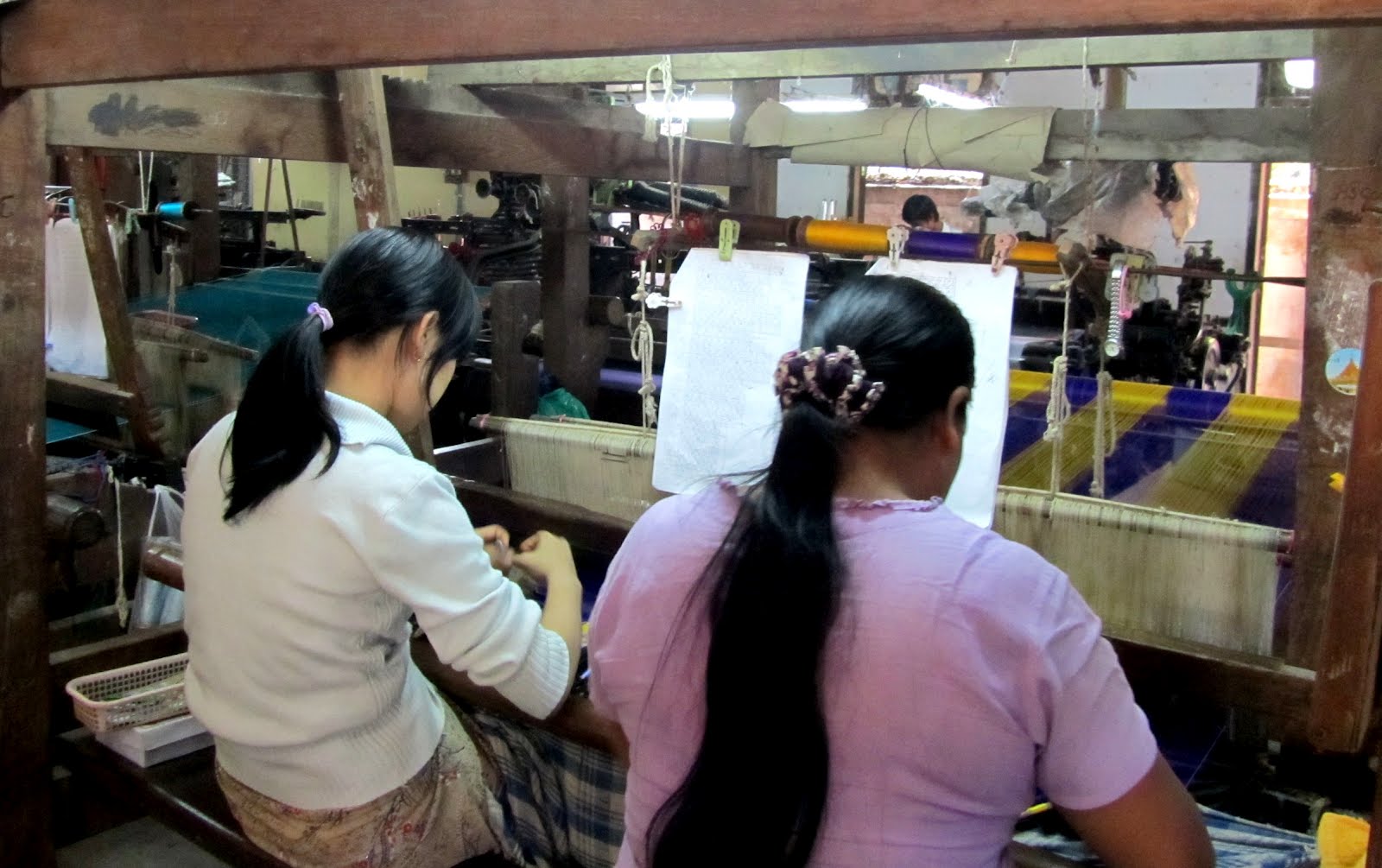
Our next stop was a weaving factory, known for making traditional wedding clothes for brides and grooms. We were told that it took 45 days to weave a bride’s dress, while only a day to make the groom’s outfit.


As we were getting ready to leave, two nuns came to the factory. Immediately, the owner came out with a food container, from which she doled out some in one nun’s begging bowl. We were told that every day monks and nuns go around town collecting alms from homes and
businesses, and the owners willingly comply.

Labels: , , ,

Jun 5, 2012

2011, DEC 17: MYANMAR, MANDALAY-A

Then we returned to Mandalay to visit the Mahamuni Pagoda, built by King Bodawpaya in 1784.


The Buddha’s image here is in sitting posture, and is more than 12-1/2 feet tall. Very likely untrue, people here believe that it was cast in the life-time of the Gautama Buddha, and that the Buddha embraced it 7 times thereby bringing it to life! Therefore, devout Buddhists hold it to be alive. Therefore, this pagoda is considered to be the area’s holiest.

After the early morning image’s face-washing ceremony, male devotees go to the upper level to put gold leaf on the image. On account of repeated layers of gold leaf, over the years, the image is about six inches fatter than it originally was.


Women are restricted to the lower level. They sit at a distance from the idol and away from males.


The pagoda has gilded hallways and railings.

A wing of the temple complex houses statutes from Angkor Wat. They were reportedly looted from there by the Thais. Later they were brought here, when Myanmar conquered and occupied Thailand for some time. We saw devotees rubbing parts of these statutes, hoping that the same
parts of their own bodies will be healed or otherwise blessed. Also, they leave money on them.

In the courtyard there was a ceremonial procession. Family members dressed in traditional dresses, and bearing gifts had gathered to honor two boys, who were getting ready for initiation
into a monastery. According to Mr. Suday, families were required to feed as many as 500 people before launching the initiation ceremony for their children.


Some children are sent to monasteries for brief periods of time, others stay there for years, if not for the rest of their life.

The pagoda has its own shopping arcade.

After lunch at an Indian restaurant, we checked into Sedona Hotel. Reception girls were nice. But other services left much to be desired.


The hotel is located right across the moat around the Royal Palace, which is now closed to the public and is being used by the military.

Labels: , ,