Pritam Rohila Travels

Reports of my travels along with some pictures

Jun 5, 2012

2011, DEC 17: MYANMAR, MANDALAY-A

Then we returned to Mandalay to visit the Mahamuni Pagoda, built by King Bodawpaya in 1784.


The Buddha’s image here is in sitting posture, and is more than 12-1/2 feet tall. Very likely untrue, people here believe that it was cast in the life-time of the Gautama Buddha, and that the Buddha embraced it 7 times thereby bringing it to life! Therefore, devout Buddhists hold it to be alive. Therefore, this pagoda is considered to be the area’s holiest.

After the early morning image’s face-washing ceremony, male devotees go to the upper level to put gold leaf on the image. On account of repeated layers of gold leaf, over the years, the image is about six inches fatter than it originally was.


Women are restricted to the lower level. They sit at a distance from the idol and away from males.


The pagoda has gilded hallways and railings.

A wing of the temple complex houses statutes from Angkor Wat. They were reportedly looted from there by the Thais. Later they were brought here, when Myanmar conquered and occupied Thailand for some time. We saw devotees rubbing parts of these statutes, hoping that the same
parts of their own bodies will be healed or otherwise blessed. Also, they leave money on them.

In the courtyard there was a ceremonial procession. Family members dressed in traditional dresses, and bearing gifts had gathered to honor two boys, who were getting ready for initiation
into a monastery. According to Mr. Suday, families were required to feed as many as 500 people before launching the initiation ceremony for their children.


Some children are sent to monasteries for brief periods of time, others stay there for years, if not for the rest of their life.

The pagoda has its own shopping arcade.

After lunch at an Indian restaurant, we checked into Sedona Hotel. Reception girls were nice. But other services left much to be desired.


The hotel is located right across the moat around the Royal Palace, which is now closed to the public and is being used by the military.

Labels: , ,

2011, DEC 17: MYANMAR, MANDALAY-B

After brief rest, we resumed Mandalay sightseeing in the afternoon. The first place we visited was the Sandamuni Pagoda.

It was built by King Mindon as a memorial to his younger half-brother, who had helped him seize power from the previous King, in 1853. Since the King Mindon had designated his half-brother as the Crown Prince, two of Mindon’s sons, disappointed in being excluded from the succession, assassinated the Crown Prince and three other princes, in 1866. King Mindon had the pagoda built eight years later, near the graves of the Crown Prince and the other members of the royal family who lost their lives in the 1866 coup.
The Iron Buddha idol was brought here by King Mindon from Amarapura. This was the seventh and last of the many journeys of the Iron Buddha, frequently moved because of wars and the shift of capitals in the nineteenth century. The statue now is covered with gold foil.

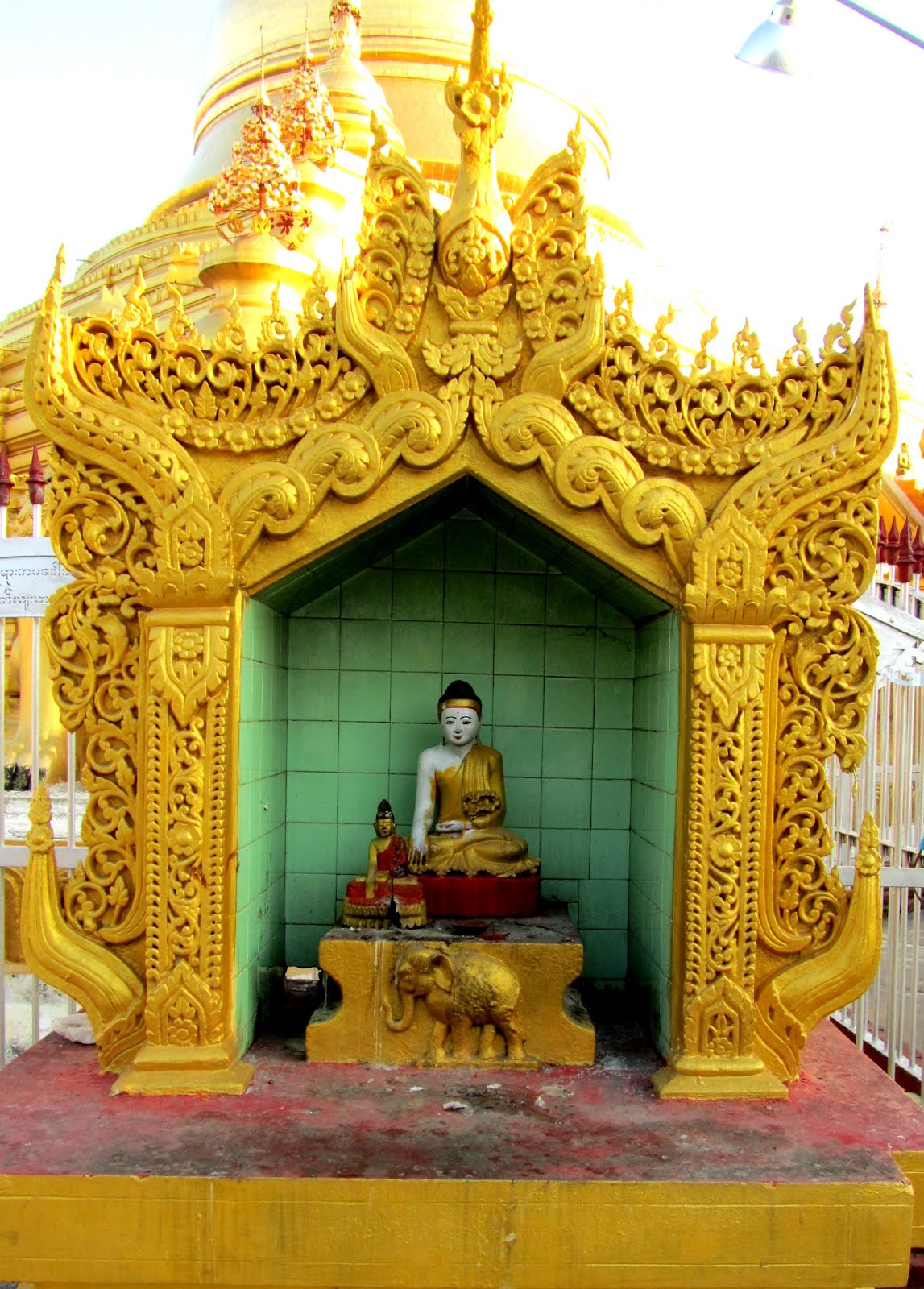
The Pagoda is surrounded by other shrines, somelarger than others.


The site is known World’s Largest Book. The “book” consists of hundreds of slender whitewashed ancillary stupas. Each stupa houses one marble slab inscribed with commentaries and sub-commentaries on the sacred Buddhist text, the Tipitaka (in the ancient Pali language meaning “Three Baskets of Buddha’s teaching”).


A similar feature characterizes the nearby Kuthodaw Pagoda.


Our last stop of the day was the Mandalay Hill for which the city was named. The hill has for long been a holy site.
The Sutaungpyei, which stands on its top, was built by King Mindon. It has been accentuated with colored mirror pieces.


One famous Buddha Image on the Mandalay Hill is the Image of Standing Lord Buddha at the top of the hill where Lord Buddha is said to have made a prophesy. But there are other images
as well, each with its own glass donation boxes, just like at all other pagodas.


Also there is a plaque commemorating the capture of the Mandalay Hill, during the Word War II, from the Japanese, by the Gurkha Rifles of the Indian Army, on the night of March 8, 1945.


Many people had gathered there. As in other parts of Myanmar, some women had painted their cheeks with a white paste to protect them from the sun.

People go there to watch the surrounding scenery, especially as the sun is setting.


Although an elevator and an escalator are also in service for going up the hill, to go down one has to use one of the four stairways. Along the stairway there are shrines, some dedicated to the native spirits of Myanmar.


Also there are various shops and hawkers. We came across Panch Ratan, a man, whose father had come from India, but he himself had never been to India. He made a living by selling Pakoras (vegetable fritters).

Labels: , ,