Pritam Rohila Travels

Reports of my travels along with some pictures

Jun 5, 2012

2011, DEC 18: MYANMAR, SAGAING

This morning we headed to Sagaing, which was the capital of Shan kingdom from 1315 t0 1364, when the grandson of its founder moved the capital to Inwa (or Ava). It is reputed for its 500 stupas and monasteries, which house about 6000 monks and nuns.

Our first stop was the International Buddhist University. Scholars from all over the world come to University to study Buddhist scriptures and practice.


It was built in 1994, by a learned monk, who had travelled to various current and ancient Buddhist nations, including India and Afghanistan. Inside are displayed pictures of various Buddhist sites he had taken during his travels.

The building is built like the 3rd century B.C. Mauryan emperor Asoka’s Sanchi Stupa in Central India. It is adorned with gateways, pillars and sculptural details from this stupa and Ashoka’s edict pillars. But certainly it is more ornate than the Sanchi Stupa.

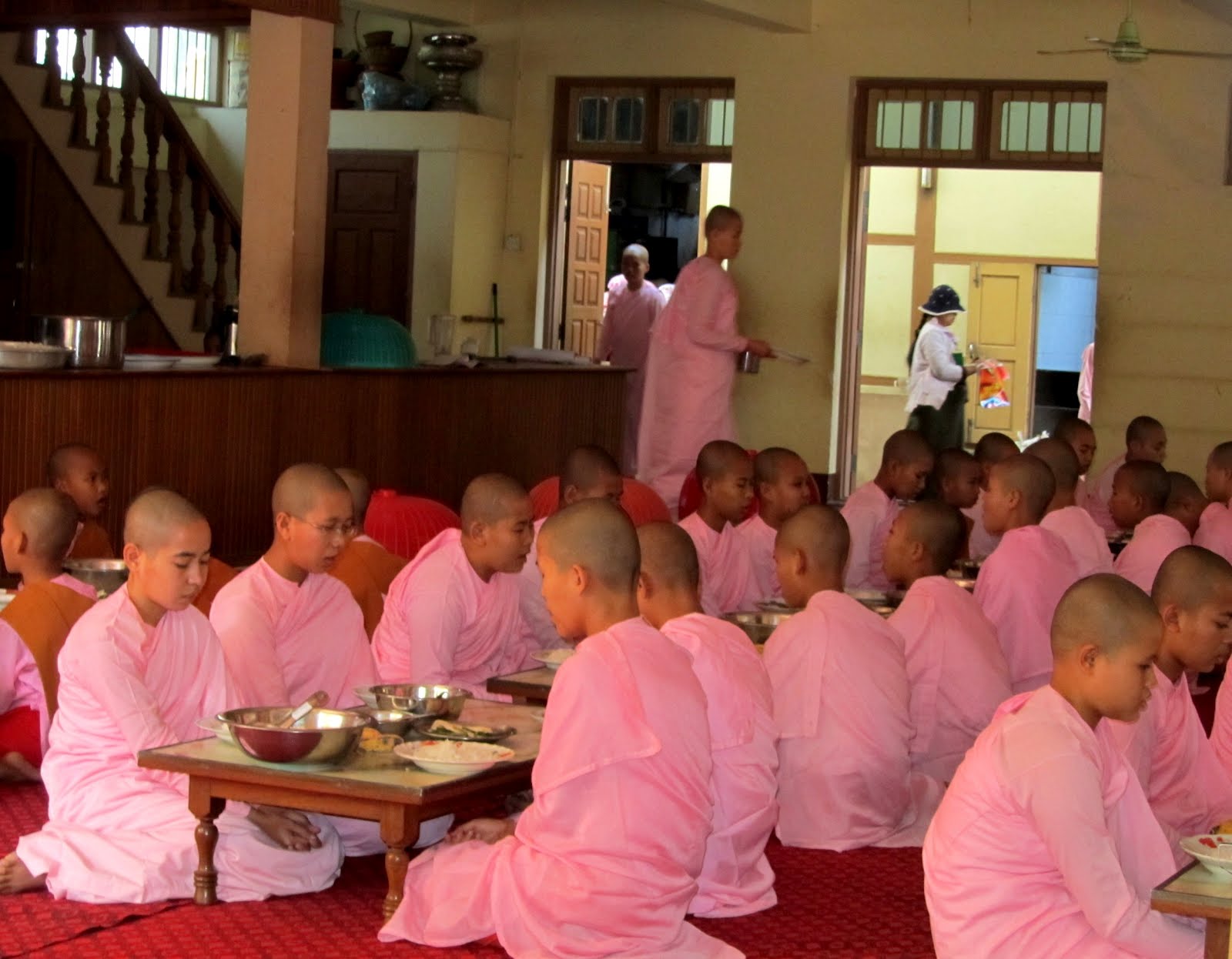
Next we visited That Kya Thida nunnery in time for their procession for the day’s meal.


Before they enter the dining hall, they leave their sandals outside, but lined in neat rows. Inside the dining hall, they all sit on the floor for their day’s only meal.


On raised platforms, behind the dining room, there are two pagodas. The older pagoda, at the highest level, has the Buddha idol built entirely from Bamboo, which was later gilded.


At the lower level is another pagoda, which has several images of Gautama Buddha, as well as of his previous and future incarnations.


Then we went up the Sagaing Hill, where according to Myanmar legend, the Buddha himself visited and made the area’s 99 ogres his disciples.

We visited Umin Thounzeh, with its crescent-shaped, cave-like colonnade with 45 Buddha images, one for each year of Lord Buddha’s teachings. Each image has a plaque bearing the donors’ names.


Soon U Ponya Shin Paya was our next target.


It was built on “the Frog Hill’, the highest peak, in 1312 by a prime minister. A painting in the sanctuary portrays the prime minister and the King.

A large frog statute stands in the temple to serve as a donation box.
Visitors pose for photographs.


Labels: , ,

Jun 4, 2012

2011, DEC 18: MYANMAR, INWA-A

After lunch, we headed to Inwa. After the Shan conquered Sagaing in 1364, the capital was moved here, and named Ratnapura, “the City of Gems.” But in 1782 the town was packed up and moved about 8 kilometers to the Northeast, to the Amaraputra.

In 1823 the entire capital was dismantled again and rebuilt 8 kilometers Southwest in Ava. But in 1838 Ava was damaged by an earthquake, and was therefore in 1841 packed up again and once more transferred to Amarapura. However, only 16 years later the entire town was moved again this time 12 kilometers to the Northeast to the present Mandalay.

Due to all this movement, and the 1838 earthquake, very little remains of the royal buildings. The villages that have now grown up on the site of the former capital portray rural atmosphere – paddy fields, rustic dwellings on stilts, and unpaved, rough roads.


As Inwa is situated on an island between the Rivers Irrawaddy and Myitnge, we had to board a ferry to go across the River Irrawaddy.


But before we could get to the boat, we had to face a group of young, but persistent hawkers. The youngest one was the most persistent of them all. She even asked Kundan, her name, and
warned her that she would be waiting for on her return from Inwa.


Across the river, we had to use a horse carriage to go places. It was a long, bumpy ride on dusty, potholed roads.


Our first stop was a factory where iron bowls are made for use by monks and nuns to collect alms. Our guide, Mr.
Suday, explained the process to us.

Nanmyin, the 'leaning tower of Inwa,’ is all that remains of the royal palace built by Bagyidaw. The upper portion this 90-ft high masonry watchtower was shattered by the 1838 earthquake and the rest has taken on a precarious tilt.


Also there are ruins of some pagodas. Some have intact
Buddha shrines.


The Maha Aungmye Bonzan Monastery, however, is relatively well preserved. More well-known as Me Nu Oak Kyaung, this monastery was commissioned by King Bagyidaw's principal wife, Me Nu, in 1818. It is built of stone in traditional style, with elaborate stucco ornamentations that look like carvings.

Labels: , ,

2011, DEC 18: MYANMAR, AMARAPURA- U Bein’s Bridge

Eventually we came to the famous U Bein’s Bridge. This picturesque 1300-yard foot bridge is located about 6 miles south of Mandalay.


It was built by U Bein, in the mid-19th century when the capital of Innwa (Ava) Kingdom moved to the nearby Amarapura.

Reputed to be Burma’s most photographed sights, U Bein’s Bridge is the world’s longest teakwood bridge. It is supported by 1,060 posts.

There are five small, covered resting areas all along the bridge. Vendors also use them to hawk their wares.

The bridge spans across the shallow Taungthaman Lake. Indispensable to the daily life of local
people as hundreds of them use it as the main passage to go to the other side and to points in between.


Tourists add international touch to the local scene. They also are a source of additional income to the area’s pagodas, shops, hawkers, restaurants and transporters.


It
It gets more crowded around sunrise and sunset, when the local commuters use the bridge. Also tourists come at this time to welcome and say farewell to the sun for the day.


After the sunset, we headed back to our hotel.

Labels: , ,